Python stacks and queues use collections.deque → linked-list based
- Same for doubly linked list Operations to know
- len(D)
- D.appendleft(e)
- D.append(e)
- D.popleft(e)
- D.pop()
Hash table in python is implemented as dict
- Remember, separate chaining (bucket has its own container) and open addressing to deal with collisions
- Python uses random probing vs linear/quadratic probing
Trees
- Binary tree - ⇐ 2 children
- Binary search tree - all left descendents ⇐ n ⇐ right descendents
- Complete binary tree - every level fully filled except rightmost descendents on last level
- Full binary tree - Each node has either 0 or 2 children
- Perfect binary tree - every level filled Tree vs Graph?
- Tree is just a restricted DAG - child can only have one parent
- Valid tree has n-1 edges from nodes Traversing a tree:
- DFS - preorder, inorder, postorder

- BFS
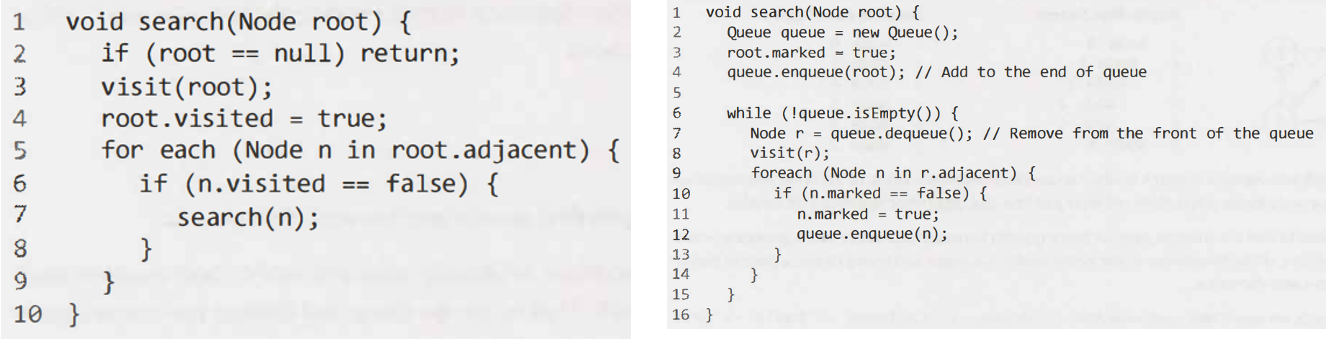
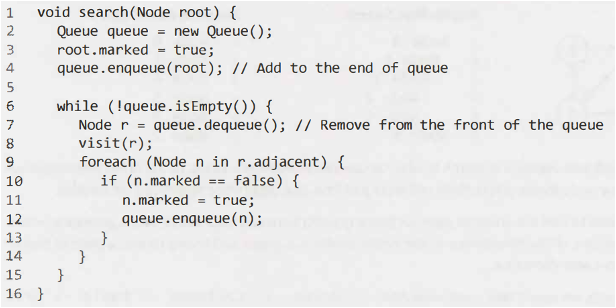 Traversing a graph vs Tree
 - For graph, need to mark nodes visited in DFS otherwise might be infinite loops
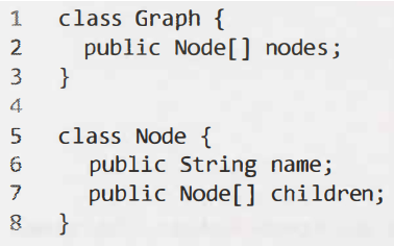
 3 ways to describe a graph
 - Directly in node class
- Adjacency list
- Adjacency matrix
Heaps imported from heapq
- Python defaults to min heap - make value negative for max heap (negate heappush and then negate after heappop)
- heapq.heappush(heap, i) - Insert is O(log n) - Add element to bottom and bubble up swapping
- heapq.heappop(heap) - Extract min, replace with bottom right element, bubble down
- Keep track of top-k largest element - do this using min heap, when heap is full (at k numbers), add element and then remove smallest
Priority Queue - takes {key, value} pairs, then removing elements starting with minimum key
- Implement with unsorted linked list, sorted linked list and min heap
Trie/Prefix tree
- n-ary tree - commonly for storing english language, quick prefix lookups
Python Set
- Unordered, have unique elements, and mutable
- Use X = set() or X = {1,2,3} or X = set(array)
Dynamic Programming
- Top-down approach (memoization) - recursive approach, solve by solving subproblems and storing subproblem results (memoized) so do not need to recompute
- Bottom-up approach (Tabulation) - solve all related subproblems first, then build up solution to larger problems
- Best way to show difference - Fibonacci
- Memoization (recursion) - return fib(n-1) + fib(n-2)
- Tabulation (start with n=1, n=2, start solving n=3)
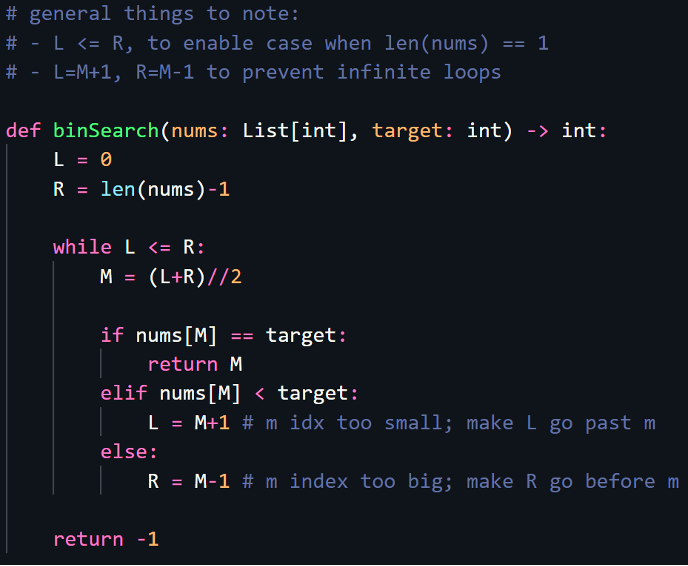
Binary Search Implementation
Topological Sort
- Take a directed graph - return array of nodes where each node appears before all the nodes it points to
- Useful for solving scheduling - compilation in makefiles for example